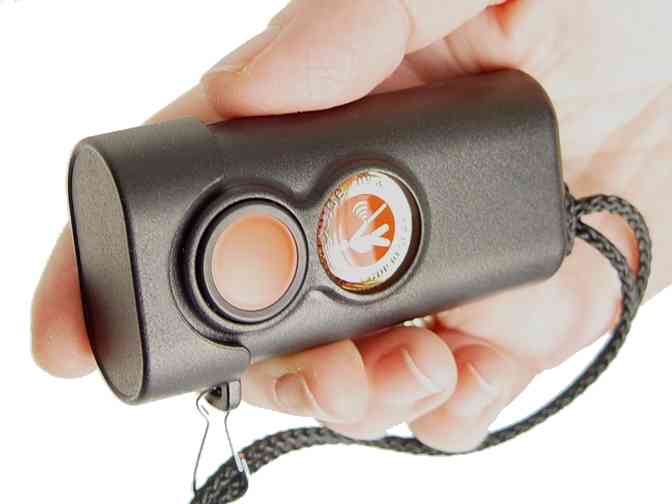
The Miniguide mobility aid
The Miniguide uses ultrasonic echo-location to detect objects. The aid vibrates to indicate the distance to objects - the faster the vibration rate the nearer the object. There is also an earphone socket which can be used to provide sound feedback.
The Miniguide supplements the information provided by a guide dog or a cane. The Miniguide is not to be used as a primary aid.
First - some comments from Miniguide users
"I had nine months of using a long cane between guide dogs and I could not have done it without the mini guide. I have just got a new dog and am finding it useful still." M.
"Just wanted to say as a person with retinitis pigmentosa I love the mini guide. It helps fill the gaps my tunnel vision had taken away. It is also fantastic in offices as I can move around and it picks up if something is in the way. For those of us with rp it is the perfect tool." L.
"Dear GDP Research, I have used sonar-based travel aids since 1994 including both Miniguide models, the Kay sonar, Mowat sensor, most of them out there. I found the miniguide invaluble in the 5 years I used the older model, and the 3+ years I used the current one."
".. my 9 months old miniguide is still on the same battery."
"..The other advantage of the miniguide is that you can scan in totally different directions to where your cane is pointing. For example, you can scan at 90 degrees to your direction of travel if you are trying to locate or count doorways or light poles etc."
The Miniguide is only intended as an accessory to the more traditional aids such as the white cane and guide dog. The Miniguide is not a replacement for these primary aids, it should only be used as a secondary aid.
The Miniguide can not detect drop offs. So please rely on your primary aid in areas where drop offs might be present, for example, railway stations, near stairs and so on.
People should only use the Miniguide once they have read and understood the instructions, as the instructions include important information and warnings about its use. People who may have difficulty understanding the instructions should only use the aid under expert supervision. Children should only use the aid under adult supervision.
Back to topThe Miniguide uses ultrasonic echo-location to detect objects. The aid vibrates to indicate the distance to objects - the faster the vibration rate the nearer the object. There is also an earphone socket which can be used to provide sound feedback.
The aid utilises the latest electronics to provide excellent robustness, reliability and battery life. The battery will normally last for many months.
A single push button is used to switch the aid on or off and also change settings. The aid has various modes and options. The main modes are:
Only large objects can be detected at 4 meters or beyond, for example, fences, walls.
Cane and guide dog users have found that the Miniguide has assisted them in many ways, including:
More detailed information about the operation of the Miniguide can be obtained by reading the User Manual.
Back to topExcerpt from Horizons Newsletter
The following are some more comments from people using the Miniguide.
"The Miniguide is an extremely important breakthrough in the area of mobility aids for totally blind people. It is exquisitely small, powerful and inexpensive." - Andrew Downie (Andrew is possibly the world's longest-term user of electronic aids.)
"I've used the Miniguide intensively over the last few weeks and have now come to depend on it as an integral part of my mobility. ..... It's early days with the Miniguide for me yet, but so far I'm very impressed. Well done!" - Mike
"Perhaps you would find it useful if I were to share my experience of the device. I bought it two years ago. I have good long cane mobility skills, regularly travelling around London and the UK without much assistance. I am totally blind. I used the guide a bit after buying it, but I am a bit lazy and decided it was too much like hard work to carry it around and get it out of my pocket when I needed it! But the other week someone parked a skip on a pavement near where I work. My cane slid under the tailgate of the skip, and I hit it. I walk fast, and the impact split my nose open! I've done this loads of times before, but this was the worst accident I have had. When I got home, my wife was really upset, and said I ought to do something about the situation! So I thought I'd better try your guide again. It really is excellent. I am using it to find my bus-stop without tapping at it with my cane, and, while walking through a crowded tube station, to tell me whether there is someone in front of me. It also warns me about lamp posts before my cane does. I have it on the four metre setting most of the time. While walking along the other day, it warned me there were people walking in front of me. It kept vibrating at a constant level even though I was moving. I could not work this out at first, and thought the battery was going. But then I realised that the object it was picking up reflections from must be moving at the same speed as me, and that therefore the object must be human. I then sidestepped a bit, as they were going too slowly. I used the guide to find the gap between the other pedestrians and the wall, and overtook them!! I can't do this with my cane as I would trip them up. I am still learning with it, and I think I'll get more out of it with practice." - Stuart
"The greatest success I've experienced (so far) has been using the 4 meter mode outside when I've needed to find a mailbox and trash can. I know approximately where they are, but my dog doesn't cooperate when I'm looking for them because they're on the way home, and he's convinced I really mean to go to the subway station. I know the area they're in, but with him, he pulls back when I'm looking for them because he doesn't want me to run into them. With your device, I was able to locate them, and hear when I was getting close enough to reach out and touch them. Without your device, I've given up in frustration because I've felt around, reaching out into empty space, and gotten concerned about wandering off the sidewalk into traffic. With your device, I found what I wanted, walked up to it, and deposited what I needed to, and went on my way happily." - Jeffrey
"As for the Miniguide, I'm enjoying experimenting with it. It's nice to be able to search for hallways and such while walking down the middle of a hall instead of near the wall. I'm also enjoying the ability to get a better sense of how far something is from me." - Anna
Back to topMiniguide Frequently Asked Questions (FAQ).
Back to topThe present Miniguide combines both tactile and audio feedback.
Guide Dogs NSW/ACT have created a high quality audio version of the Miniguide instructions on CD. They have been kind enough to allow a copy of the instructions to be available from this web site. The 5 tracks of the instructions are in MP3 format and are highly compressed so they will fit on this web site (the sound quality is similar to listening to AM radio). Please remember that you have to download all 5 tracks to get the complete instructions.
There are two older Miniguide models. The first Miniguide of these older models provided feedback to the user via audio only. The second provided tactile feedback only. Both of these older models had a cloth covering instead of the present hard plastic case.
Back to topThe Miniguide is available from the following organisations:
LS&S in the USA. www.lssproducts.com LS&S
PAMTRAD in the UK and Europe. www.pamtrad.co.uk Pamtrad
Within Australia, please contact your local mobility agency. The following is a list of organisations that have bought significant numbers of Miniguides (and can provide training):
All our research is funded from our sales. If you would like to help our research into developing new products for vision impaired people, please donate using the button below. Please note that we are not a charity so donations are NOT tax deductible.
Here's a short history of the development of the Miniguide.
There have been lots of different electronic travel aids. Sadly, most of them are no longer available. We think the Miniguide is pretty good because it is reliable, robust, has a long battery life and is small - and with your support, it is still being manufactured. For your interest, here is a list of some of the past and present electronic travel aids: